

Write Effective AI Prompts: Examples for Your Generative AI Tool
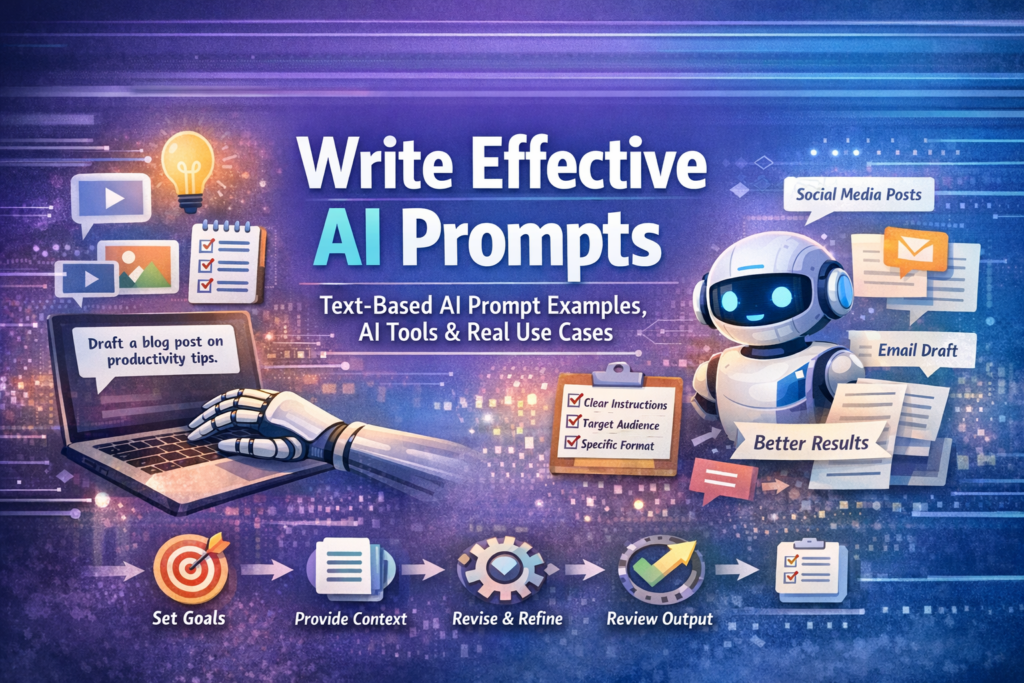
If you’ve ever felt frustrated by the output from a generative AI tool, you’re not alone. The secret to unlocking the full potential of artificial intelligence lies in understanding how to craft the right prompt. This comprehensive guide will teach you everything you need to know about writing effective prompts that deliver exactly what you’re looking for.
Whether you’re new to AI or looking to refine your skills, you’ll discover practical AI prompt examples, proven prompting strategies, and real-world examples that will transform how you interact with AI systems. By the end of this article, you’ll have the knowledge to harness the power of AI and dramatically improve your productivity.
Throughout this guide, you will find various ai prompts examples that illustrate the art of constructing effective prompts for different applications.
What Makes a Good Prompt for AI Systems?
Knowing what makes a good prompt separates those who struggle with AI from those who get exceptional results every time. At its core, a good AI prompt provides clear instructions that guide the AI toward producing the output you actually need. Think of it like having a conversation with a knowledgeable assistant—the more specific and clear you are about what you want, the better results you’ll receive.
Think of a prompt as your communication channel to the AI’s vast capabilities. When you write an AI prompt, you’re giving instructions to an AI model using everyday language rather than programming code. Through natural language processing, the AI decodes your words to grasp context, figure out what you’re asking for, and determine the best way to respond. That’s precisely why crafting your prompt carefully has such a direct impact on the quality of your results from AI.
AI Prompts Example for Enhancing Your Skills
The best prompts share common characteristics: they are clear and concise, they provide relevant context, and they specify the desired format or tone. When you give the AI enough information to understand your request without overwhelming it with unnecessary details, you create the conditions for success. Remember, the AI can help you accomplish remarkable things, but only if you learn to communicate effectively with it.
How Do AI Prompts Work Behind the Scenes?
Before you can write effective AI prompts consistently, it’s valuable to grasp the mechanics of how prompts work under the hood. Generative AI platforms rely on machine learning models that have absorbed enormous quantities of text-based information during their training phase. The moment you enter a prompt, the AI processes your request and constructs a response by drawing on patterns it discovered while learning.
Prompts guide AI by establishing the parameters of the task. When you ask AI to write a blog post about marketing, for example, the prompt activates relevant knowledge the AI has about marketing, blog writing conventions, and content creation. The more specific your prompt, the more precisely the AI can tailor its output to your needs. This is why detailed prompts consistently generate better results than vague requests.
Effective prompt engineering means leveraging this knowledge deliberately to shape outcomes. Each word you choose steers how the AI interprets your request and shapes the resulting output. Your prompts act as a focusing mechanism, directing the AI’s extensive knowledge base toward the precise information your task requires. Once you internalize this principle, you’ll find yourself writing better prompts and receiving far more useful responses.
What Are the Best Practices for Writing Effective Prompts?
Following best practices when writing a prompt dramatically improves your success rate with AI tools. The first principle is clarity—always provide clear instructions about what you want the AI to accomplish. Vague prompts lead to vague output, while specific prompts yield targeted results.
Begin with concrete, detailed descriptions of your desired outcome. Rather than prompting the AI to “write something about dogs,” you’ll achieve far better output with something like “write a 500-word informative article about the health benefits of adopting senior dogs for families with children.” This specificity communicates not only the subject matter but also the expected length, appropriate tone, and your target audience. When you guide AI with specific parameters, you’re more likely to receive content that meets your exact needs.
Another essential practice is providing context and examples. When you need the AI to replicate a certain writing style, embedding specific examples directly into your prompt makes a significant difference. You might say, “Write in a conversational tone similar to this example: [insert example].” Prompts like these give AI the reference points it needs to calibrate its output. Additionally, always review and iterate—your first prompt rarely produces perfect results, so treat prompt writing as an ongoing conversation where you refine your requests based on the AI’s responses.
Can You Share Simple AI Prompt Examples for Beginners?
Let’s explore some simple AI prompt examples that demonstrate effective techniques in action. These examples of ai prompts will help you understand how to structure your own requests for optimal results.
For content creation, a basic but effective AI prompt might be: “Write a 300-word introduction for a blog post about sustainable fashion targeting environmentally conscious millennials. Use a friendly, informative tone and include one surprising statistic.” This prompt clearly defines word count, subject matter, intended readers, voice, and a particular component you want included. The AI can help produce focused content because you’ve given it clear boundaries.
When you need to write an email, try a prompt like: “Draft a professional email to a client explaining a two-week project delay. Express genuine apology, provide a brief reason, and propose a new timeline. Keep it under 200 words.” For social media marketing, you might prompt: “Create five engaging Instagram captions for a coffee shop’s new seasonal menu. Include relevant hashtags and a call-to-action in each. Target audience: young professionals who appreciate artisanal coffee.”
These prompts you can use demonstrate how specificity leads to better output. Pay attention to how each example communicates precise expectations about structure, word count, intended readers, and voice. Using ai prompts successfully requires this kind of deliberate planning before you even begin typing your request.
How Can Prompt Engineering Improve Your AI-Generated Content?
Prompt engineering is the systematic approach to crafting prompts that consistently produce high-quality ai-generated content. This discipline has emerged as professionals recognize that the quality of AI output depends heavily on input quality. By treating prompt writing as a skill to develop, you can dramatically improve your results.
Advanced prompt engineering techniques include role assignment, where you ask the AI to adopt a specific persona. For instance, “Acting as an experienced financial advisor, explain the basics of retirement planning to someone in their twenties.” By assigning a role, you enable the AI to adjust its vocabulary, underlying assumptions, and how thoroughly it explains concepts. You can also use prompts to structure complex tasks by breaking them into steps: “First, outline the main arguments. Then, develop each argument with supporting evidence. Finally, write a compelling conclusion.”
Iterative refinement represents another highly effective technique. Write your initial prompt, review what the AI produces, then fine-tune your approach based on what you observe. Should the AI deliver content that feels overly stiff or formal, revise your prompt to explicitly request a more relaxed, conversational style. If the output lacks depth, ask for more detailed prompts in your follow-up. This iterative process is like having a conversation where you guide the ai toward increasingly precise results. Over time, you’ll develop intuition for writing ai prompts that work on the first try.
What Are Effective AI Prompts for Content Creation Tasks?
Content creation represents one of the most popular use cases for AI, and effective ai prompts can revolutionize your workflow. Whether you need to write a blog post, create social media content, or develop marketing copy, the right prompt makes all the difference.
For blog writing, effective ai prompts include detailed specifications: “Write a blog post about the benefits of meditation for busy professionals. Include an engaging introduction, five main benefits with practical tips for implementation, and a motivational conclusion. Target length: 1,200 words. Tone: warm, encouraging, and evidence-based.” This prompt gives AI enough context to produce publication-ready content.
When creating a social media post, good ai prompts are concise yet specific: “Write a LinkedIn post announcing our company’s achievement of carbon neutrality. Highlight our three-year journey, thank team members, and inspire other businesses to pursue sustainability. Professional yet celebratory tone, approximately 150 words.” For video content, you might prompt the AI to write a script: “Write a script for a 60-second explainer video about our new project management app. Focus on the three main features that save time for remote teams. Conversational tone suitable for a voiceover.”
These real examples show how prompts help shape AI output for specific platforms and purposes. By tailoring your prompts to each content type, you ensure the AI produces appropriate material that serves your communication goals.
How Do You Write a Great AI Prompt for Business Applications?
Business applications demand precision, and a great ai prompt for professional contexts requires careful attention to requirements and constraints. From drafting a response to a customer inquiry to creating technical documentation, business prompts must balance clarity with completeness.
When you need to write a technical document, your prompt might read: “Create a user guide section explaining how to set up two-factor authentication in our software. Assume the reader has basic computer skills but no technical background. Include numbered steps, potential troubleshooting tips, and security best practices. Formal but accessible tone.” This type of prompt communicates your precise requirements while setting appropriate expectations for technical depth.
For customer communications, prompts should specify tone and outcome: “Draft a response to a customer who complained about delayed shipping. Acknowledge their frustration, explain the supply chain issue briefly, offer a 15% discount on their next order, and assure them of improved service. Empathetic and solution-focused tone.” Prompts give ai the parameters needed to represent your brand appropriately. In business contexts, telling AI about your company values and communication standards produces output that aligns with your professional identity.
What Mistakes Should You Avoid When Writing AI Prompts?
Understanding common mistakes helps you craft better prompts from the start. Many users struggle with AI because they don’t give ai enough information or context. A prompt like “write about marketing” is too vague—the AI has no way to determine length, audience, focus, or purpose, leading to generic output that rarely meets actual needs.
Another frequent error is being overly complex. While detail is good, cramming too many requirements into a single prompt can confuse the AI and produce disjointed results. If you have a complex project, break it into multiple prompts that build on each other. Start with an outline, then develop sections individually. This approach lets you guide the ai toward a coherent final product through manageable steps.
Neglecting to define your desired format creates unnecessary problems. When you need bullet points, state that requirement explicitly. If you need a conversational piece rather than formal prose, make that clear. AI systems like ChatGPT default to certain patterns, and without explicit direction, you might receive content that requires significant editing. Also avoid assuming the AI knows your specific context—always provide relevant background information. The perfect prompt doesn’t exist in a vacuum; it’s tailored to your unique situation and goals.
How Can You Use ChatGPT and Similar Tools for Better Results?
ChatGPT and similar generative AI tools have made AI accessible to everyone, but getting better results requires strategic thinking. When you use AI platforms like ChatGPT, remember that these systems respond best to prompts that balance specificity with flexibility.
One effective strategy is to ask AI to explain its reasoning or provide alternatives. You might prompt: “Suggest three different angles for a marketing campaign targeting first-time homebuyers, and explain the strategic reasoning behind each approach.” This encourages the AI to generate diverse options while demonstrating the thinking behind each suggestion. You can then select the direction that best fits your goals.
Another tip for using platforms like ChatGPT is to leverage follow-up prompts. Your first prompt starts the conversation, but subsequent prompts can refine and improve the output. If the initial response misses the mark, ask the AI to adjust: “That’s a good start, but can you make it more conversational and add specific examples?” This iterative approach, where you ask AI to revise based on feedback, produces superior results. Remember that AI helps you most when you engage with it actively rather than passively accepting initial output.
How Will Learning More About AI Prompts Boost Your Productivity?
Investing time to learn more about AI prompts pays dividends across your personal and professional life. When you master prompt writing, you save time on routine tasks, improve the quality of your output, and unlock creative possibilities you might never have explored otherwise.
Consider the productivity gains: what once took hours of writing, researching, or brainstorming can now be accomplished in minutes with the right AI tools and prompts. Using AI prompts effectively means you can quickly draft documents, generate ideas, create content outlines, and tackle tasks that previously created bottlenecks in your workflow. The AI generates initial drafts or frameworks that you then refine, combining artificial intelligence efficiency with human judgment and creativity.
Beyond efficiency, AI prompts expand your capabilities. You can ask ai to help with tasks outside your expertise, like technical writing, creative storytelling, or data analysis summaries. The AI doesn’t replace your skills—it augments them. By describing what you want clearly and providing the right context, you access capabilities that would otherwise require specialized knowledge or significant time investment. This democratization of capability is why understanding AI prompts has become an essential skill for the modern professional.
Key Takeaways: Mastering AI Prompts for Success
Here’s a summary of the most important things to remember about writing effective AI prompts:
- Always provide clear, specific instructions in your prompts to guide the AI toward producing the exact output you need
- Include relevant context about your target audience, desired tone, format, and purpose to help the AI tailor its response
- Use detailed prompts with concrete requirements rather than vague requests to generate better results consistently
- Practice prompt engineering by iterating on your prompts and treating AI interaction like having a conversation
- Break complex tasks into smaller prompts to maintain quality and coherence across longer projects
- Specify format explicitly—if you want lists, paragraphs, or specific structures, tell the AI directly
- Review and refine your prompts based on the output you receive, adjusting until you achieve desired results
- Leverage AI for productivity by using prompts to draft, brainstorm, and create content that you then enhance with your expertise
- Avoid common mistakes like vague requests, information overload, and failing to provide adequate context
- Remember that great prompts are investments—time spent crafting the right prompt saves significantly more time in revisions and rework